
The dream that changes things
A Japanese master of dream divination instructs me in a dream.

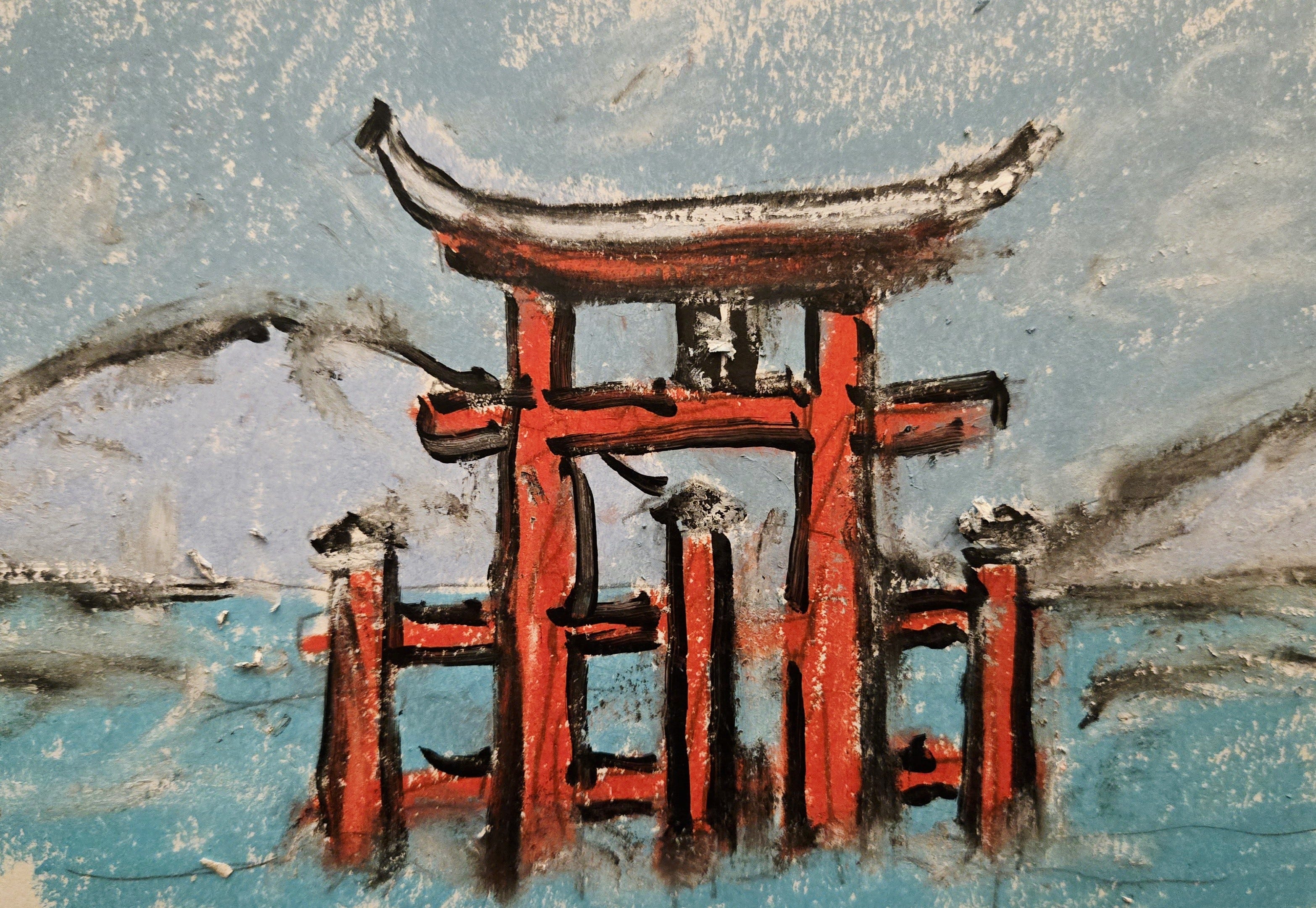
To say he is old school is like calling a shark a fish. Dark suit, perfectly tailored to his neat, well-turned body. His English, almost unaccented, is mostly Oxbridge. His small talk is of literature, and English country pubs, and Jermyn Street shirtmakers. They call him minster. I don’t know his exact affiliation and I think his real name is probably not Kimura. There is a rumor today that he has come into some privileged information, privileged even by the standards of a group cleared for top secret ultra.
The fat man in the Japanese delegation whispers that Kimura had a shanga last night. I don’t know the word. My first thought is of shagging. But no, a shanga is some kind of dream. A really big one, pointing in several directions, capable of blowing up in many places, like a piñata - or a cluster bomb. I can’t find out what this dream is about, but its aura adds to Kimura’s air of quiet omniscience. I don’t doubt he knows things that are not in the briefing books or in the whispered exchanges in the rooftop bar.
I get out my phone and search for shanga online. It doesn’t live in Japanese. AI tells me officiously that it is probably a “mishearing” of shunga, a term for a kind of erotic print that was especially popular in the Edo period. On the third day of the conference, when Kimura surprises me by inviting me to his suite, I begin to see a connection.
There is large portfolio on the coffee table, sheathed in a glorious floral fabric. The minister tells me it is the fabric that was also used to dress the sofas in the grand receiving room of a great country house in England. The cover is old and worn but holding up well.
The minister motions for me to join him on the sofa. He opens the portfolio and I see it is full of watercolors, many in the vibrant Gansai style. He chooses a picture for me. It shows a nobleman in a palace looking out on a garden where his phantom double is wandering with a terrible animal, half boar and half bear, at his side.
“My great grandfather hired the best artists to paint his dreams,” Kimura tells me. “This picture shows how dreams are made.”
I know this matter. It is the monomyth of indigenous and archaic cultures: in sleep, a double – call it soul - leaves the body and travels near or far. Dreams are memories of its travels, or of visitations by other travelers. I did not expect to be talking about this with a minister at the conference.
“Your ancestor worked for the Imperial Department of Divination.”
He inclines his head. “You are well informed.”
“Would I be wrong to assume that the Department of Divination is still operation?”
He laughs. “This calls for sake.”
While he warms the alcohol, I stretch my legs. I glance through the picture windows at the man-made mountains and abysses of the island city. I notice the divination kit on a side table. Yarrow stalks, ink brushes and ink, high quality paper.
We toast, to happy dreams coming true.
“Your portfolio makes me think of those albums high officials had made in Qing dynasty China. Visual autobiographies. They hired artists to depict big events in their lives. Sometimes these included dreams.”
“My family did the same, except that we gave priority to dreams.”
“Will you tell me about the shunga? If that is the right term.”
“Shunga is a joke. Some dreams are shockers. Sex may be part of that, but not the most important part. There is a kind of dream we call kawaru yume. The Dream That Changes.”
“You mean a dream that changes its story line?”
“You find yourself stepping into a restaurant on a spring day, and when you go to the restroom the door opens on a mountain wilderness in a blizzard. Kazuo Ishiguro does that well. Yes and no. Kawaru yume is about more than dream logic and oneiric geography. It’s seeing which world we are in, and whether we need to stay there.
“There is the yochi yume, the dream in which you see what will happen. This is useful, to prepare for events that are otherwise unseen. It may be a clear dream, that requires no interpretation, or a symbolic dream, which does, or an upside-down dream, that means the reverse of what it seems to say. The kawaru yume is more important. You not only see the future, you can lean in to make it change.”
“Can you explain how that works? Is this some kind of lucid dreaming?”
“Not the kind that makes out a dream is only a dream, so you can fool around without consequences. We know that what we do in kawaru yume has consequences, not only in the dream world but in the mortal world.”
I notice the shift in his vocabulary. He is now calling ordinary reality the mortal world, reminding us that what travels in dreams is a part of the self that survives the death of the body.
“Of course you read The Man in the High Castle. Not the television series. The novel by Philip K. Dick.”
I’ve read it three times.”
“Then you remember the Japanese trade minister, one of the rulers of occupied California, who turns to the I Ching for counsel. And how at the end the man who has written what everyone thinks is dangerous fiction discovers he has written truth, when he is helped to see through a hexagram of the I Ching. Hexagram sixty-one, Zhong Fu or Inner Truth. When he looks through the hole in the middle of the hexagram, as through an oculus, Amendsen realizes that the world he imagines, in which the Allies won the Second World War, is real. There is a real world – this sounds curious today – in which the swastika is not flying over the East Coast, and Japanese militarists aren’t running the Left Coast. The author understands that to see something as it really is – to see through Inner Truth – is to change the world.
“This is the nature of The Dream That Changes. Few people will see one, or understand what they see. Those who do can be deadly, or deliverers. How much of either depends on migration.”
“Migration?”
“On how many minds receive The Dream That Changes. Most will not remember the dream they received, or that the world was different before it came.”
He collects the sake cups. My audience is at an end. “We will have more to share,” he tells me. “Find me in your dreams.”
As I pass the side table, on my way to the door, I see that an image has been inked in fine brushstrokes on the top page. I recognize hexagram sixty-one, Inner Truth, with the hole at the heart through which you can see what is really real.
Author Note
I wrote this story from a dream in which I was told, at a conference, that a Japanese minister had experienced a shanga. The word “shanga” was a term for a shocker of a dream, a dream cluster bomb. Waking, I could not find “shanga” in a Japanese dictionary but my search triggered a cluster of connections like the Japanese Imperial Department of Divination. This was a real agency, part of the Ministry of Religion, that monitored dreams as well as natural portents and sought messages through readings of the I Ching and dream incubation at sacred sites.
In imperial Japan, one-third of the officials in the Ministry of Religious Affairs — the Jingikan — were assigned to the Department of Divination. Their job was to read patterns of coincidence and advise the emperor accordingly. They had many techniques for provoking a sign from the world, including heating a turtle shell and reading the cracks and monitoring nighttime activity in the Shinto and Buddhist shrines where priests and supplicants went to ask for an oracular dream. But the task of the divination office was also to advise on the meaning of spontaneous signs and coincidences: the fall of a comet, an incident at a bridge, the case of three doves who strangely pecked each other to death.
Control of the Jingikan was reserved for one family, the Urabe clan. We can assume that in early days this family produced a strong line of seers who were successful at seeing into the world “behind,” and at provoking signs and oracles from the other side. They did not need a code to tell them what it meant when the crack in a turtle shell ran a certain way or when birds formed a certain pattern in the sky.
Later, as the diviners become less like wizards and more like civil servants, they followed tedious and elaborate rules. Carmen Blacker, a wonderful scholar of Japanese oracles and shamanism, wisely observes in her book The Catalpa Bow that “these rules, in the form in which they have come down to us, are no more than dead, hardened residues left behind by the passing of the gifted seer.”
The Japanese term for divination is ura or uranai. It means getting in touch with “what is behind.” The word for an oracular dream is reimu. Yochi yume (予知夢, yochimu) is a Japanese term that translates to “precognitive dream”. Kawaru yume (変わる夢) literally means “changing dream”. Kimura’s explanation does not appear to be public information.
Illustration by RM