
On the Imaginal Realm
Visiting the Place Outside of When

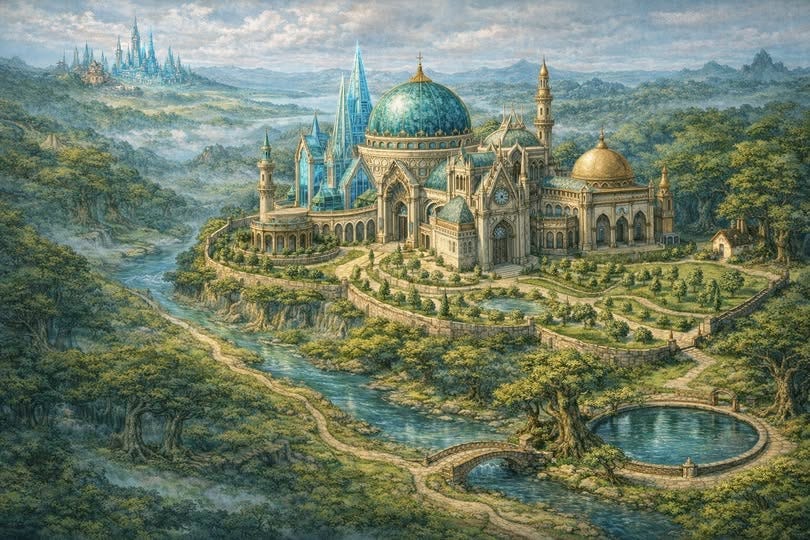
The imaginal realm is a fundamental ground of knowledge and experience. It is a region of mind between the world of time and the world of eternity. In this realm human imagination meets intelligences from higher realities, and they co-construct places of healing, instruction and initiation. Here ideas and powers beyond the grasp of the ordinary human mind – call them archetypes or Platonic Forms – take on guises humans can begin to perceive and understand. It is a place beyond place where human minds meet intellects and intentions from beyond the human range. There are structures here – temples and palaces, schools and cities, pleasure gardens and places of initiation and healing.
The term “imaginal realm” is an attempt at translation of two terms used by mediaeval Islamic mystics who were frequent visitors: Alam al-Mithal, or Realm of Archetypes, and Alam al-Khayal, or Realm of Images. Henry Corbin, the great French scholar of mystical Islam, encouraged us to use “imaginal” instead of “imaginary” in describing this reality. If we call something “imaginary,” we usually mean it is “made up,” something other than real. Yet poets and mystics have always known that the world of imagination is a real world — a third kingdom between the physical universe and the higher realms of spirit — and that it is possible to travel there and bring back extraordinary gifts.
Corbin described the imaginal realm as “a world as ontologically real as the world of the senses and the world of the intellect, a world that requires faculty of perception belonging to it….This faculty is the imaginative power, the one we must avoid confusing with the imagination that modern man identifies with ‘fantasy’ and that, according to him, produces only the ‘imaginary.’”[1]
Imaginal may not be a household word in the English language – unlike in French, where you can speak of l’imaginaire without needing to explain – but it is worth getting to know it, because it affirms the reality of experience in realms beyond the physical where adventure and initiation, higher education and deep healing, are all available.
The Persian mystics also call the imaginal realm the Place Outside of Where, Na-koja-Abad. It is “a climate outside of climates, a place outside of place, outside of where” In its eastern region, in the city of Jabarsa, is the realm of the spirits who have moved beyond physical existence, and “the forms of all works accomplished, the forms of our thoughts and desires.”[2] It is an “isthmus” between the realm of pure light and the darkness of the physical world. It is a realm of “suspended form” – dark as well as light – that may be renewed or destroyed, like images in a mirror, through the faculty of imagination. [3]
When we approach the great visionary philosophers of medieval Islam, we find ourselves in the presence of extraordinary minds that could “cross over”, at will, into true realms of imagination. They have given us a geography of nonordinary reality, and an insight into the power of the imagination to create and reshape worlds, that is of immense contemporary value.
Two medieval masters, Suhrawardi and Ibn al’Arabi, share the understanding that imagination is a “creative magical potency” that gives birth to forms in more than one world. [4] The universe itself begins when God imagines (or dreams) it. The Realm of Images - is the “place of apparition” of spiritual beings. “It is also the place where all ‘divine history’ is accomplished” – the place of the greater drama beyond the surface dramas of our lives and our world [5]
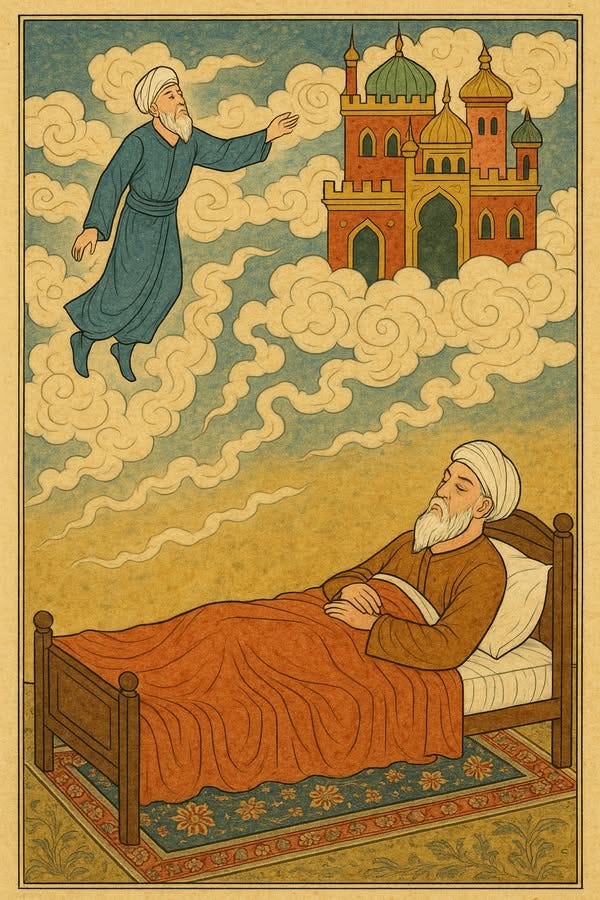
The imaginal realm is also a place for living humans to meet ascended masters. Sadruddin Qunyawi, a disciple instructed by Ibn Arabi in Konya, described his ability to meet the masters in various places of encounter: “Our sheikh Ibn Arabi had the power to meet the spirit of any prophet or saint departed from this world, either by making him descend to the level of this world and contemplating him in an apparitional body (surat mithaliya), similar to the sensible form of his person, or by making him appear in his dreams, or by unbinding himself from his material body to rise to meet the spirit.”[6]
In this realm we are beyond the physical but we do not go about as disembodied thought forms. The Persian commentator Mulla Sadra Shirazi, described the Imaginal Realm as “the world of the subtle bodies… a world in which we have subtle or imaginal bodies as we have a physical body in this world.” According to Mulla Sadra, the subtle world “has even more reality than the physical world.”
Suhrawardi’s philosophy of “illumination” and his vivid descriptions of the Realm of Images were founded on his own visionary journeys, which began on a night when he fell into “a dreamlike ecstasy” and met a radiant guide who said, “Awaken to your self, and your problem will be solved.” [7]
Later Suhrawardi explained that this encounter had not taken place in his room, but in a shining city called Jabarsa, located in the Imaginal Realm. “The encounter with suprasensory reality” may come through divine visitation but the heart of the practice is astral travel. The adept’s physical body becomes “a tunic which he sometimes casts off and at other times puts on” He puts on another body – a “robe of auroral light” to travel to higher realms and “if it pleases him, he can manifest himself in whatever form he chooses.” [8]
The Realm of Images has countless cities each of which has a thousand gates. The mixed population includes many beings who are not even aware that humans exist on a planet called Earth.
Suhrawardi insisted both on the objective reality of the imaginal realm and on fact that the way to grasp it is the way of experience: “pilgrims of the spirit succeed in contemplating this world and they find there every object of their desire…I myself have had trustworthy experiences, indicating that there are four worlds”, he declared in his masterwork, the Hikmat al-Ishraq (“The Philosophy of Illumination”), speaking with the authority of direct experience. To know the world of true imagination, you must go there yourself
The imaginal realm may be the source of new creation in the physical world. In its deeper levels, it is closely related to what Seth, speaking through jane Roberts, was content to call a “dream universe”:
Your universe and all others spring from a dimension that is the creative source for all realities - a basic dream universe so to speak, a Divine psychological bed where subjective being is sparked, illuminated, stimulated, pierced by its own infinite desire for creativity…The source of its power is so great that its imaginings become worlds, but it is endowed with a creativity of such splendor that it seeks the finest fulfillment, for even the smallest of its thoughts and all of its potentials are directed with a good intent that is literally beyond all imagining. [9]
You are no stranger to the imaginal realm, even if you do not remember the dreams in which you may have traveled at least to its suburbs. That curious house you keep visiting in night dream may be your pied-à-terre in some quarter of an imaginal city. In this chapter you will be invited to visit some very interesting locales in the imaginal realm from which previous travelers have returned with reports of encounters with master teachers, privileged access to a total library, portals for time travel, and experiments in reality creation.
NOTES
1. Henry Corbin, “Mundus Imaginalis, or the Imaginary and the Imagined” in Swedenborg and Esoteric Islam, trans. Leonard Foc. West Chester, PA: Swedenborg Foundation, 1995, p. 9.
2. Henry Corbin, Spiritual Body and Celestial Earth: From Mazdean Iran to Shi’ite Iran trans. Nancy Pearson.Princeton: Bollingen, 1998, pp. 126-7.
3. Roxanne D. Marcotte, “Suhrawardī’s realm of the imaginal” Ishraq: Islamic Philosophy Yearbook 2. Moscow, 2011, pp. 68–79
4. Corbin, Henry, Creative Imagination in the Sufism of Ibn ‘Arabi. Trans. Ralph Mannheim. Princeton: Bollingen, 1981), p.179.
5. Ibid, pp. 189-90.
6. Book of Conversations in Corbin, Spiritual Body p. 124
7. Corbin, Spiritual Body pp. 118-9
8. ibid, p. 224.
9. Jane Roberts/Seth, Dreams, ‘Evolution’ and Value Fulfillment (New York: Prentice Hall Press, 1986) vol. 1, Session 897.
Illustrations: RM+AI